
The UK job market has been described as slow and sluggish with many employers putting hiring on hold. With the rise in minimum wage many firms are finding it hard to afford labour. Data from the Office for National Statistics (ONS) shows total vacancies have fallen to 712,000. This is said to be the lowest it has been in five years. With a rising population it is seen as impossible for some to find work.
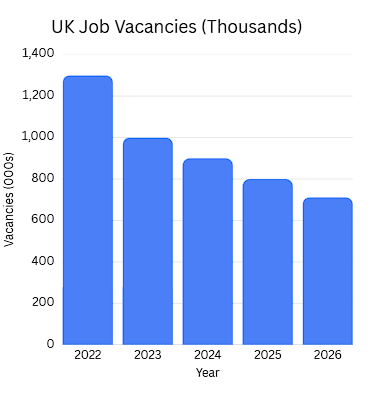
Many firms have reported that it is more economical and efficient to use Artificial Intelligence rather than use labour. With AI becoming more advanced, more firms are starting to utilize the software rather than hire employees. Artificial Intelligence is increasingly being used in sectors such as accounting and copywriting, reducing demand for some entry-level tasks.
With new governments and leaders, policies are continuing to change to try to increase employment in the UK. Increases in National Insurance contributions and in National Living Wage have made it unaffordable for businesses to recruit new staff. This has caused numerous firms to freeze employment.
In a time of economic recovery from the pandemic many employers are finding it hard to recruit new employees due to low capital. Furthermore the cost of living has caused consumer spending to decrease leading to lower profit for firms. Instead of expanding businesses many employees would rather control costs and cut down on expenditure where necessary.
Experienced professionals with several years of experience are benefiting in sectors such as healthcare, engineering and technology. Businesses are also benefiting by cutting costs using AI and improving efficiency. School leavers without experience and qualifications are finding it harder than ever to secure jobs. Young people seeking part-time work have less opportunities as businesses reduce hiring. Graduates can find it harder to secure entry level jobs due to increased competition and a higher volume of applicants.
In general, the current job market is the result of several pressures acting at once, including higher employment costs, slower economic growth, technological change and cautious business confidence. While some sectors continue to recruit, graduates and young people are facing one of the most competitive entry-level job markets in recent years.
Sources & Further Reading
Office for National Statistics (ONS) – UK job vacancies, employment and labour market data.
Bank of England – Interest rates, inflation and economic conditions.
HM Treasury – Government tax and employment policies.
Office for Budget Responsibility (OBR) – Economic forecasts and public finances. Institute of Chartered Accountants in England and Wales (ICAEW) – AI and its impact on the accounting profession.
BBC News Business – Current affairs and labour market reporting.
Unsplash (Photo by Israel Andrade) – Hero image.